
Quick Look
A Temperature Quilt records daily temperatures through color-coded fabric blocks, one per day, across a full year. You can start a 2026 Temperature Quilt in April using free historical weather data for January through March. The late-starter plan needs three decisions before Block 1: your block shape, your temperature range, and whether you are tracking the daily high, the low, or both.
Related: 3-Yard Quilts: The Viral Pinterest Trend Saving Your Stash
What Is a 2026 Temperature Quilt and Why Is Everyone Starting One?
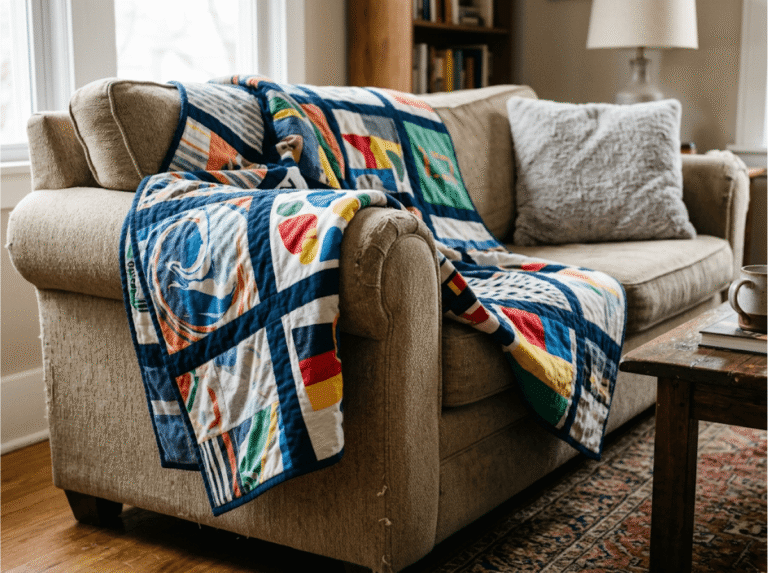
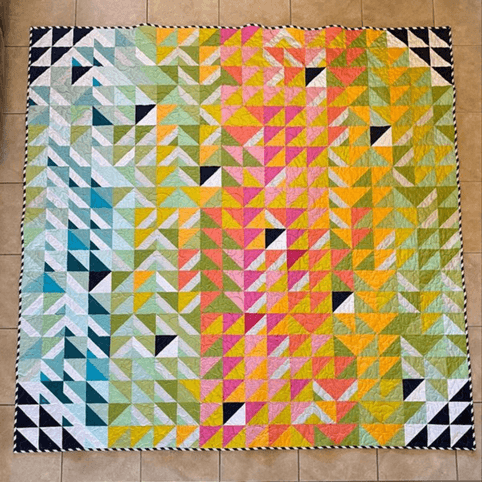
A Temperature Quilt is a year-long patchwork project where each block represents one day’s temperature. You assign a color to each temperature range. You sew one block per day (or catch up in batches) using the color that matches the day’s high or low. At the end of the year, your finished quilt is a visual record of the weather you lived through.
The 2026 version is everywhere right now because the American Quilter’s Society and Quilters Select launched an official “semi-controlled, improvisational, mystery 2026 Temperature quilt” stitch-along in January. Reddit’s r/quilting and Instagram have been stacking progress posts ever since. The result is a second wave of makers joining in April.
If you are late to the trend, you are not actually late. Temperature quilts do not require a January 1 start date. They require a decision and a first block.
Can You Start a Temperature Quilt in April?
Yes. Free historical weather data from Weather Underground, NOAA’s National Centers for Environmental Information, and local airport weather stations lets you backfill any date you missed. You have two valid paths.
- Path A: Backfill January through April. Pull daily high and low temperatures for the 114 missed days from a historical source. Pre-cut those 114 pairs of squares in one Sunday session. Stitch the backfill alongside current-day blocks. You will be caught up by late May.
- Path B: Fresh start April 1. Label your quilt “April 2026 to March 2027.” Twelve months, 365 blocks, no backfill. One maker finishing her 2020 quilt in the fall of 2021 wrote, “Good thing I could go back and look up what those high temperatures had been!” The historical data is always there.
Both paths are legitimate. Pick the one you will actually finish.
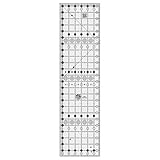
- Made in the USA with high quality acrylic and precision measurements ensuring accuracy for your quilting, sewing, patchwork, and crafting projects.
- Creative Grids exclusive non-slip grip allows you to easily slide the ruler over the fabric until positioned correctly. Then, when slight pressure is applied, the grip holds the ruler in place, eliminating slipping while you cut.
- Easy to read black and white markings printed in 1in grids marked in 1/8in and 1/4in increments are highly visible on most fabric colors.
- Use the black numbers printed on white dots and 1/4in grip side to cut whole inches.
- Use our exclusive Turn-a-Round feature to cut 1/2in increments by following the white numbers on black dots and 1/2in grip sides.
Which Quilt Block Patterns Are Best for Beginners?
Block complexity is the single biggest predictor of whether your Temperature Quilt survives June. The rule: choose a block you can cut and sew in under 10 minutes.
Under 10 minutes per block (beginner path):
| Block | Pieces | Seams | Notes |
| Half-square triangle (HST) | 2 | 1 | Magic 8 method yields eight at once |
| Simple rectangle strip | 2 | 1 | Fastest option, lowest fabric waste |
| Charm square with center | 3 | 2 | Adds visual interest, stays fast |
15 to 25 minutes per block (intermediate path):
| Block | Pieces | Seams | Notes |
| Drunkard’s Path | 2 | 1 curved | Builds curved-piecing skill |
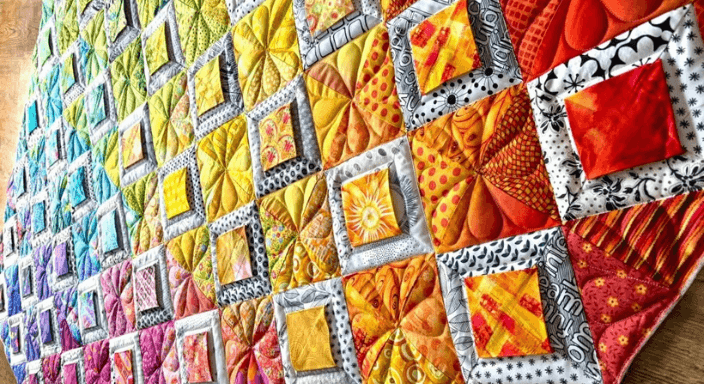
| Dresden wedge | Multiple | Multiple | Quilters Select 2026 official block |
| Pineapple foundation block | Many | Many | One block per month, not per day |
For a first Temperature Quilt, go simple. Complex blocks wait for Year Two.
How Do You Set Up Your Temperature Ranges?
Before you buy fabric, check your local climate’s historical range on Weather Underground or NOAA. Look at the past five years. Note your typical annual low and your typical annual high.
Standard intervals:
- 5-degree ranges are the default. Works for most climates.
- 3-degree ranges suit temperate climates like the Pacific Northwest, where most days cluster in a narrow band.
- 10-degree ranges only if your climate is extreme, like Phoenix summers or Minnesota winters.
Most Temperature Quilts need 14 to 22 color pairings. Write your ranges on a swatch card before ordering any fabric. Then decide: daily high only, or high and low? One maker put it plainly, “I decided that my chances of sticking with this project would be much greater if I kept it simple.” Tracking only the high cuts your block work in half.

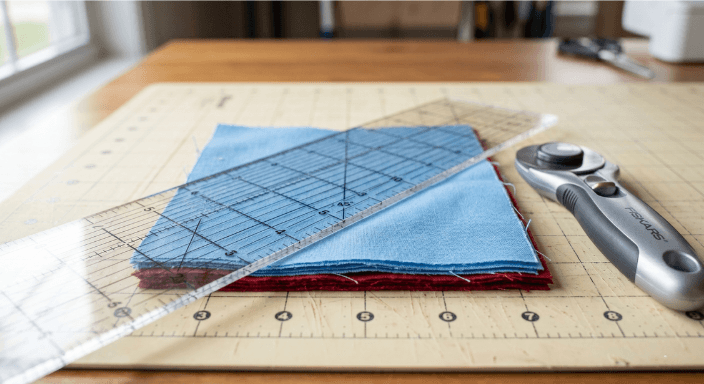
- RAZOR SHARP 45MM ROTARY BLADE - The 45mm Rotary Cutter is pre-loaded with an RB45 Rotary Blade made from high-quality tungsten tool steel. The ultra-sharp rolling razor blade delivers unparalleled sharpness and superior edge retention.
- COMFORTABLE & DURABLE HANDLE - The ergonomically curved handle with anti-slip rubber grip reduces hand fatigue and stress. Integrated grooves help prevent finger slippage and provide stable and comfortable cutting. Hang-hole provides easy storage.
- QUICK & EASY BLADE REPLACEMENT - OLFA's 45mm Rotary Cutter has a quick-change blade system that provides simple and safe blade changes. The split blade cover allows one edge to be exposed at a time and you can switch hands without changing parts.
- INTRICATE & ACCURATE CUTTING - Provides detailed and precise cutting of fabric, paper, tarp, leather, vinyl, and more. Perfect for cutting strips and multiple layers at once for sewing, quilting, and crafts.
- THE OLFA STANDARD - As the original inventor of the Snap-Off Knife, OLFA has maintained a standard of cutting excellence for our quality and durability. Pairing your OLFA 45mm Rotary Cutter with OLFA 45mm Rotary Blades will provide optimal results.
How Do You Calculate Fabric Yardage for 365 Days?
The working estimate for 365 small HST blocks at 3″ finished:
| Fabric Use | Cut | Typical Quantity |
| Mid-range temperature colors | 1/2 yard | 10 to 14 fabrics |
| Extreme cold and extreme heat colors | 1/4 yard | 4 to 8 fabrics |
| Background fabric | 3 yards | 1 fabric |
| Backing | 4 yards | 1 fabric |
| Binding | 1/2 yard | 1 fabric |
| Batting | 72″ x 84″ | 1 piece |
Shop your stash first. The fabric you already own will cover 40 to 60 percent of your Temperature Quilt palette. One practitioner recommends pre-cutting patches in advance and storing them in bags labeled by temperature, “That way, all I have to do is sit down, grab two patches and stitch them together.”
Budget range for a stash-supplemented project: $75 to $175 in new fabric.
How Do You Stay on Track for 365 Blocks?
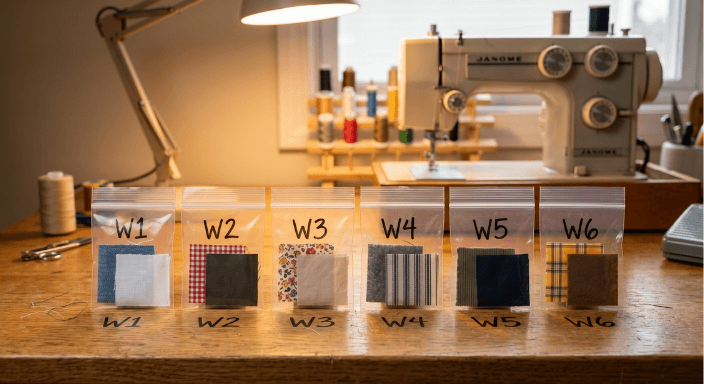
Pre-cut monthly. Not daily. On one Sunday a month, cut the next 30 pairs of squares, bag them by date in labeled ziplocks, and store them next to your machine. On sewing days, you grab the bag and stitch. No decisions.
- Realistic rhythm: Five to ten blocks per Sunday afternoon. Not one block every evening. The “block a day” framing is aspirational, not operational.
- Allow a margin. One practitioner wrote, “Allow yourself a margin, it’s okay to get behind X number of blocks, because we all know life can throw you some curve balls.” Two weeks behind is normal. Two months behind is recoverable in a long weekend with historical data. Eighteen months behind is still a finishable quilt.
What Tools Are Required to Start a Temperature Quilt This Week?
No affiliate relationships are disclosed in this piece. Budget tiers below reflect typical US retail pricing and are not product endorsements.
Under $30 (stash-first start):
- Rotary cutter (if you already own one, use it)
- Your existing cutting mat
- Your basic quilting ruler
- Your existing sewing machine, calibrated to a clean 1/4″ seam
$30 to $150 (intentional upgrade):
- 6″ x 24″ quilting ruler (the standard size for HST work)
- 24″ x 36″ self-healing cutting mat
- 1/4″ presser foot for your machine, if not already owned
$150 and up (long-term investment):
- Quarter-inch ruler with lip
- Die cutter for HSTs at scale (optional)
- Thread organizer
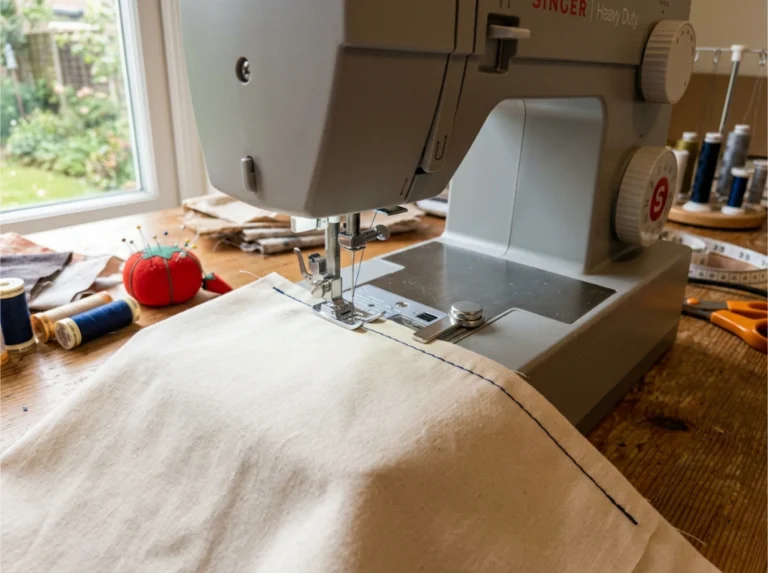
Calibrate your seam allowance before Block 1. A 1/32-inch drift in your 1/4″ seam compounds across 365 blocks. By block 180, your quilt will not square up. Sew a test strip of five seams on scrap fabric. Measure. Adjust. Test again. This is the single step that separates a 2026 finish from a 2027 regret.

- SELF HEALING ROTARY MAT - Our rotary mat is self-healing, it reseals surface cuts for a continually smooth cutting surface. Using a self-healing cutting mat extends the life of your blade and protects the surfaces of your work area.
- DOUBLE SIDED - Our double-sided rotary mat has one side with grid lines and one side without grid lines. Grid lines help with easy measuring and accurate cutting of straight lines and precise angles. The solid color side is used for general cutting.
- 24 INCH BY 36 INCH MAT - This rotary cutting mat is 24"x36" and 1.5mm thick. The large size makes it perfect for most crafting projects. Great for cutting multiple layers of fabric into bias strips, squares, triangles, and squaring up blocks.
- PROTECT YOUR ROTARY MAT - Our professional quality cutting mat is designed for use with rotary cutters only. Not for use with fixed blade utility knives. To prevent warping, store it flat and out of direct sunlight.
- THE OLFA STANDARD - As the inventor of the Rotary Cutter in 1979, OLFA has maintained a standard of cutting excellence for our quality and durability. Pairing OLFA brand rotary cutter, blades and cutting mats together will provide optimal results.
Your First Block Is the Hardest
Three hundred sixty-five blocks sounds impossible. Five to ten blocks on a Sunday is a Sunday habit.
You can start a 2026 Temperature Quilt in April. You can start with your existing stash. You can start with the simplest block on the list. The goal is not perfect documentation of the weather. The goal is a record of a year you lived through, stitched in your own hands.
Your Next Step: Start This Sunday
- Bookmark a historical weather source for your zip code.
- Pull fabric from your stash tonight and sort it by color family.
- Cut your first week of squares on Sunday morning.
- Download the free Starter Worksheet below and fill in Page 1 before you cut anything.
Check this video from Quiltin Stitchin and Kitties.
Frequently Asked Questions
-
Can I start a 2026 Temperature Quilt in April?
Yes. Pull historical daily high and low temperatures for January 1 through April 23 from Wunderground or NOAA, then pre-cut those 114 days of squares in one session. You can sew the backfill alongside current-day blocks. Late starts finish at the same rate as January starts.
-
What size block is best for a Temperature Quilt?
For 365 daily blocks, stay at 3 to 4 inches finished. Smaller blocks mean less fabric, faster sewing, and a manageable final quilt around 60 by 72 inches. Larger blocks balloon the quilt into king-size territory, which extends quilting time and fabric cost significantly.
-
Do I need both high and low temperatures or just one?
One is plenty. Tracking only the daily high cuts your block work in half and still produces a visual year record. High-and-low quilts are more visually complex but not inherently better. Pick the version you will actually finish by December.
-
What if I miss recording a day’s temperature?
You can look it up later. Weather Underground, NOAA, and local airport stations all keep free historical daily temperature records by zip code. No Temperature Quilt has ever been ruined by a missed recording day. The data is always recoverable.
-
How much will a 2026 Temperature Quilt cost in fabric?
Budget $75 to $175 for a stash-supplemented project with 14 to 20 fabrics. Half-yard cuts of mid-range colors plus quarter-yards of extreme-temperature colors will cover most climates. Shop your stash first, because the existing fabric you own will cover roughly half of your palette.
-
Can I make a Temperature Quilt without a sewing machine?
Yes. English paper piecing and hand-appliqué Temperature Quilts are well-documented in the quilting community. Hand sewing is slower per block but travels better, needs no machine calibration, and works well for hexagon and circle block styles. Some quilters prefer it for exactly that reason.
-
My seam allowance is slightly off. Does it matter for a Temperature Quilt?
It matters more here than on most projects. A 1/32-inch drift compounds across 365 blocks into a 6-inch discrepancy at assembly. Calibrate your 1/4-inch seam on scrap fabric before Block 1, and re-test seasonally when fabric weight shifts.
Precision check: What technical detail tipped the scales for you?