
Start Here
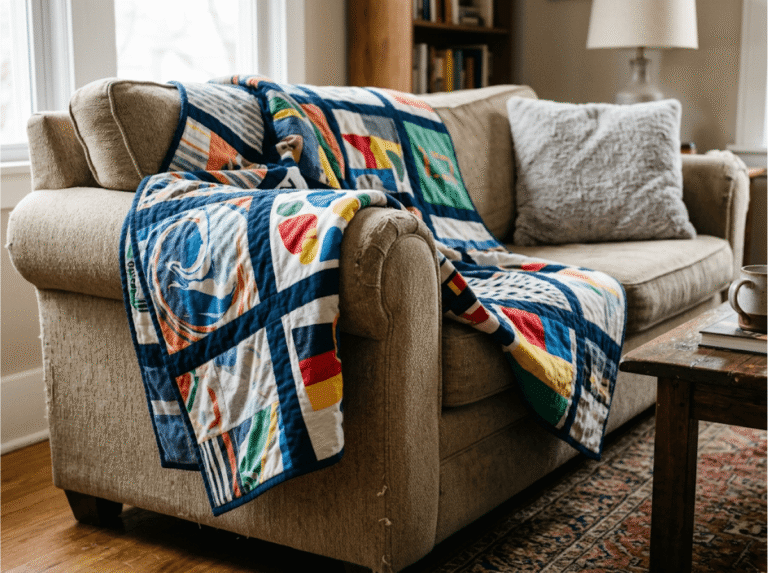
This free beginner baby blanket quilt pattern produces a 36-by-42-inch patchwork quilt using 5-inch squares and about 1.5 yards of quilting cotton. No curves, no triangles: just straight cuts and straight seams. Total build time is 6 to 8 hours. Download the free PDF below for the full cutting guide and step-by-step instructions
Related: Beginner Block Quilt: 2026 Scrappy Sampler Starter Guide
A baby blanket quilt is the best first quilting project you can make. It teaches cutting, piecing, pressing, sandwiching, quilting, and binding at a forgiving scale. This guide walks you through every step, from choosing fabric to attaching the binding.
What Is a Beginner Baby Blanket Quilt Pattern?
A beginner quilt pattern uses only straight cuts and straight seams. No curves, no triangles, and no points to match on your first project. A baby blanket quilt is the recommended starting point because the small size means less fabric, shorter construction time, and smaller mistakes. If a seam is off by an eighth of an inch on a baby quilt, it barely shows. That same error on a bed quilt compounds into inches of drift.
This pattern is patchwork: 5-inch squares arranged in a grid, sewn in rows, layered with batting and backing, quilted with straight lines, and finished with binding. As one maker put it: “A lot of folks try their hand at quilting for the first time when it’s time to make a baby quilt.” That instinct is right.
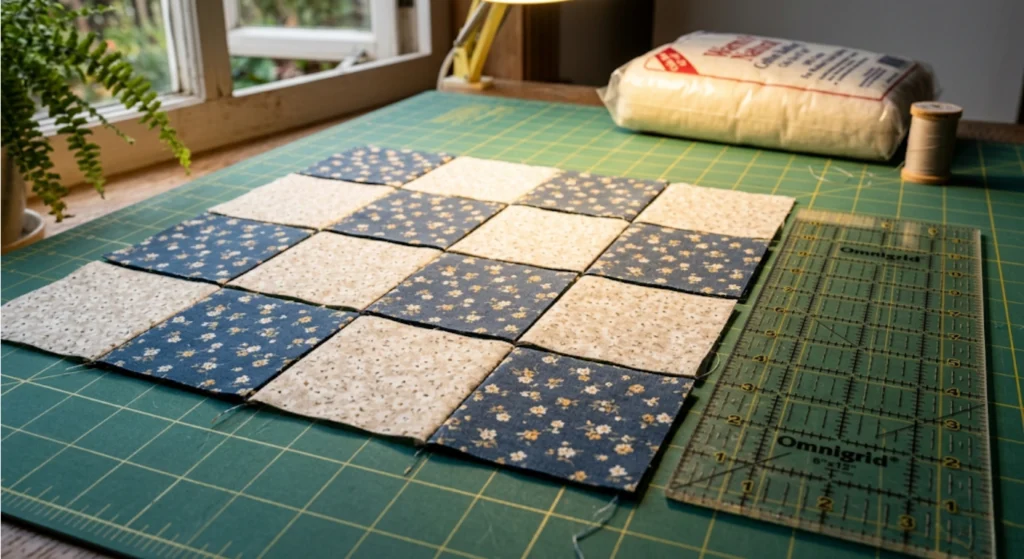
Thread Frame Prompt [Close-up of 5-inch quilting cotton squares arranged in a two-color checkerboard layout on a self-healing cutting mat, acrylic ruler resting beside the grid, warm overhead task light casting soft shadows on the cotton weave]
How Much Fabric Do You Need for a Baby Blanket Quilt?
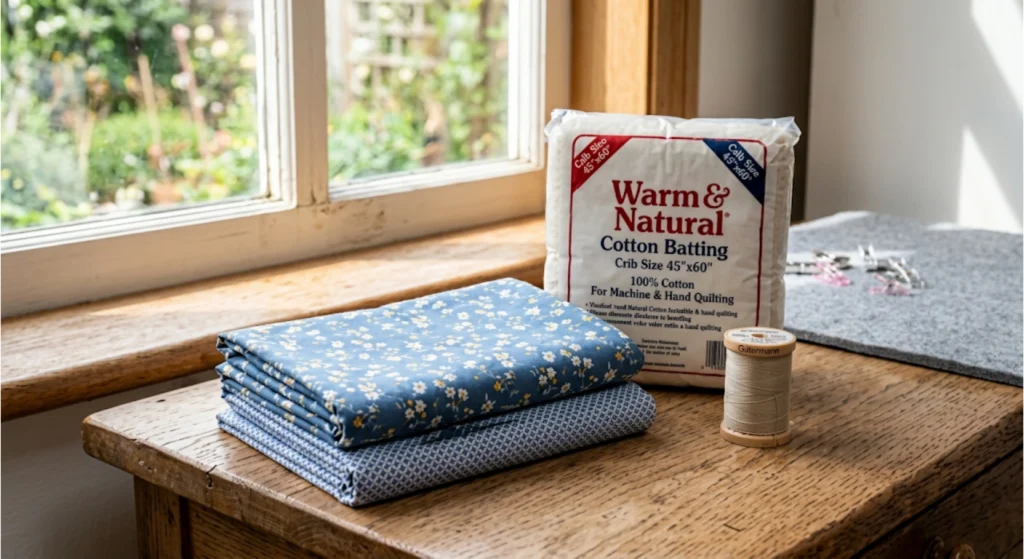
Once you have chosen your layout, gather your fabric.
- A 36-by-42-inch baby blanket quilt requires approximately 1.5 yards of quilting cotton for the top, 1.25 yards for the backing, and one-third of a yard for binding. Add crib-size batting (45 by 60 inches) and a spool of 50-weight cotton thread. Total materials cost runs $25 to $45.
If you prefer pre-cut fabric, one charm pack (42 pre-cut 5-inch squares) plus half a yard of a coordinating solid gives you enough for the top without any square cutting.
- Pre-wash all quilting cotton before cutting, because cotton shrinks 3 to 5 percent in the first wash. A finished baby blanket quilt made from unwashed fabric will pucker permanently the first time you launder it.

- SEWING, ARTS AND CRAFTS STAPLE: This Fiskars Rotary Cutter can cut multiple layers of fabric, paper, felt, and vinyl in straight lines or curves; Ideal for doing sewing, arts and crafts for adults
- PRECISION ART SUPPLIES: High-grade, precision-ground, 45mm rotary blade is perfect for projects and fabric that require precise cutting; Pair with Fiskars Self-Healing Cutting Mat to protect your work surfaces.
- LONG LASTING AND RELIABLE: Premium steel blade created for long-lasting sharpness; Fiskars craft supplies and materials are built to last
- COMFORTABLE AND CONVENIENT: Easy-to-use loop handle improves comfort and control; Sliding button extends blade during use, locks it into position and retracts it for safe storage; Blades snap in or out easily for quick replacement
- QUALITY TOOLS FOR SEWING, ARTS AND CRAFTS: From scissors and cutting mats, to rotary and paper cutters, to quilting and scrapbooking supplies, Fiskars crafting tools are designed to help you do what you do best: express yourself
What Quilting Tools Does a Beginner Actually Need?
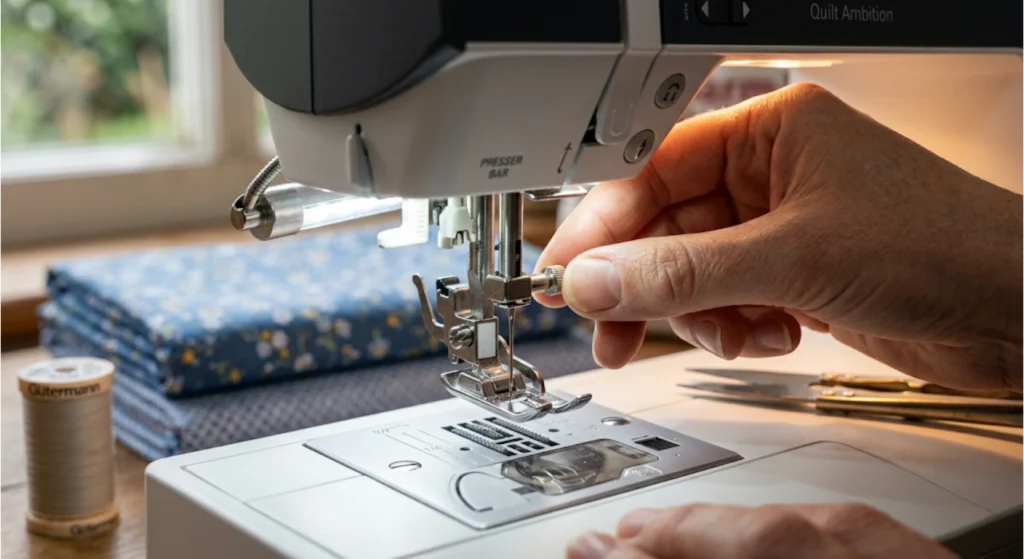
With your fabric pre-washed and pressed, gather your tools before cutting.
You need four tools to start: a rotary cutter, a self-healing mat, an acrylic ruler, and a walking foot. Everything else is either already in your sewing kit or can wait.
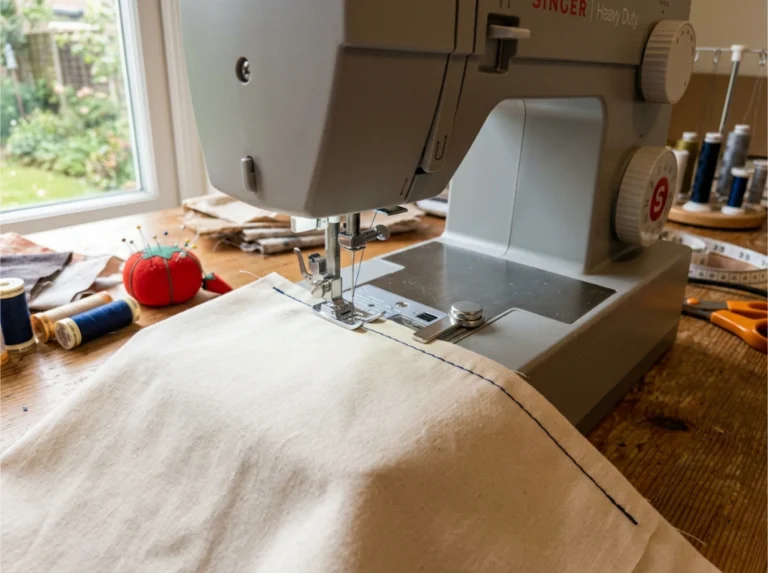
Your sewing machine needs a straight stitch, a fresh 80/12 universal needle, and a clean bobbin area. No specialized quilting machine is necessary. Before cutting fabric, run a machine pre-flight: re-thread from scratch, wind a fresh bobbin, and sew a test line on quilting cotton scrap. One sewist described the alternative: “I spent $50 on fabric, and the whole thing puckered. I don’t even know if it’s the tension, the needle, or if I broke the machine.” A 30-second test catches that.
A walking foot ($15 to $30) feeds all three quilt layers evenly during the quilting stage and is the one add-on that pays for itself on your first project. Without it, the top fabric shifts against the batting.
How Do You Cut and Piece a Baby Blanket Quilt Top?
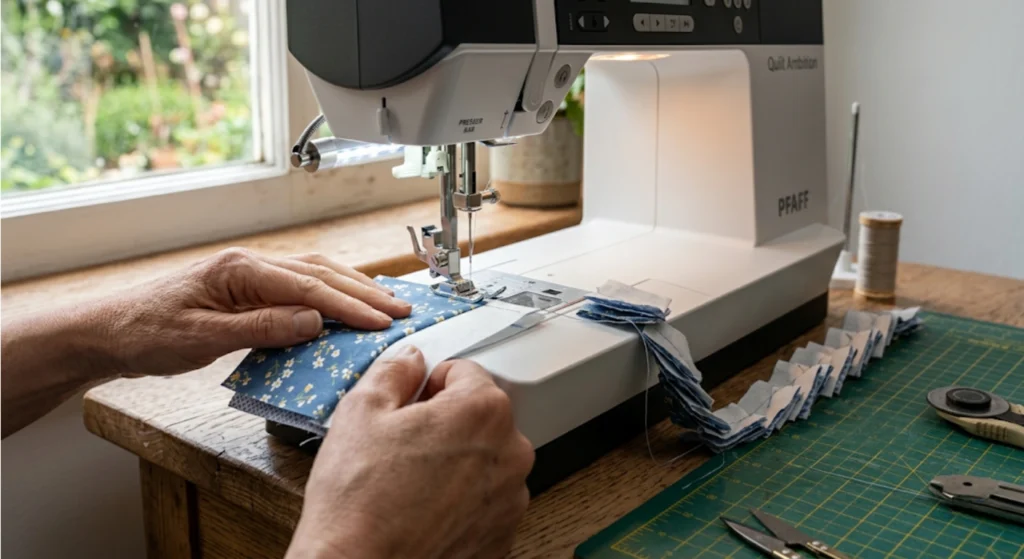
Your machine is ready, your fabric is pressed, and your tools are set. Now you build the quilt top.
The piecing sequence is: cut all squares, arrange the layout, sew squares into rows, press every row, then join the rows.
Cut 63 squares at 5 inches by 5 inches. If using two fabrics, cut 32 of Fabric A and 31 of Fabric B. Lay them out in a 7-column by 9-row grid, alternating fabrics in a checkerboard pattern. Check the arrangement before sewing.
Sew squares into rows using a consistent quarter-inch seam allowance. Chain-piece to save time: feed pairs through the machine without cutting the thread between them.
Press every row seam before sewing rows together. This is the single step that separates a flat quilt from a puckered one. Press Row 1 seams to the right, Row 2 to the left, alternating throughout. This allows seam intersections to nest when you join rows. Use a dry iron and press down without sliding.
Test your quarter-inch seam before starting: sew three 1.5-inch strips together, press, and measure the center strip. It should measure exactly 1 inch.

- SEWING, ARTS, AND CRAFTS STAPLE: Self-healing cutting mat for sewing and other projects, with easy-to-read measuring grids and 30, 45, and 60-degree bias lines that make angle cutting easy; Sized for cutting full widths of fabric right off the bolt
- PRECISION ART SUPPLIES: Great for sewing, quilting, scrapbooking, stationary, wrapping gifts, and anything that requires precision while protecting your work surface; Pair with Fiskars rotary cutters for easy and enjoyable creating
- LONG LASTING AND RELIABLE: Self-healing cutting surface lasts longer than other mats and is designed to provide you with precise measurements and results; Fiskars craft supplies and materials are built to last
- QUALITY TOOLS FOR ARTS AND CRAFTS: From scissors and cutting mats, to rotary and paper cutters, to quilting and scrapbooking supplies, Fiskars crafting tools are designed to help you do what you do best; Ideal addition to sewing kit gift sets
- INCLUDES: 1 Fiskars 18x 24" Self-healing Rotary Cutting Mat; Full lifetime warranty; Store flat away from sunlight, heat and cold; Clean with warm water and mild soap

How Do You Assemble and Quilt a Baby Blanket?
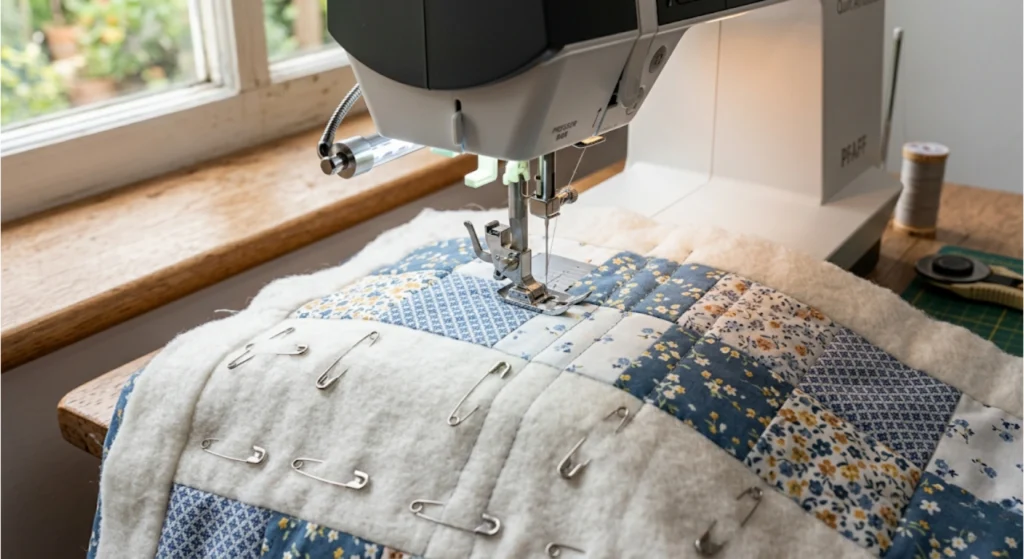
With a pressed, flat quilt top in hand, you are ready to build the quilt sandwich.
Layer the backing wrong side up, the batting centered on top, and the quilt top right side up. Smooth from the center outward and pin-baste with curved safety pins every 4 to 6 inches. Pin basting holds layers securely and requires no specialty frame.
Attach your walking foot. Set stitch length to 3.0mm. Starting from the center, sew straight lines along every vertical seam (stitch in the ditch), then along every horizontal seam. This grid secures all three layers. Remove pins as you reach them.
After quilting, trim the batting and backing even with the quilt top on all four sides. Square up each corner for clean binding.
How Do You Bind a Baby Blanket Quilt?
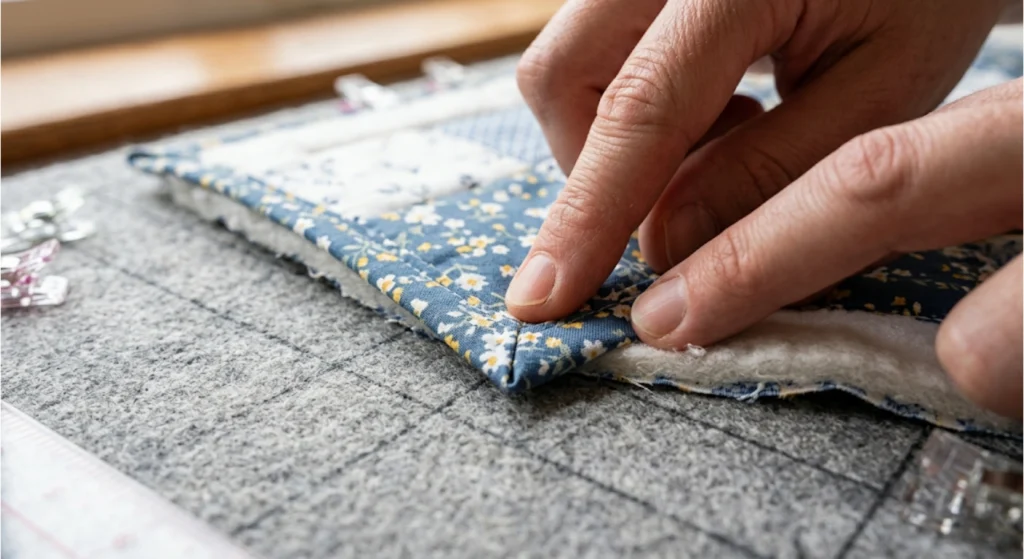
Binding is the final construction step. It wraps and protects the raw edges of your finished quilt.
Machine-sewn double-fold binding is secure, washable, and the recommended method for a first baby blanket quilt. Hand binding is a next-level skill for a future project.
Cut 5 strips, every 2.5 inches by the width of the fabric. Join strips end to end with diagonal seams, trim to a quarter-inch seam allowance, and press the seams open. Fold the entire binding strip in half lengthwise, wrong sides together, and press.
Align the raw edges of the binding with the quilt front and sew with a quarter-inch seam. Stop a quarter inch before each corner, backstitch, fold the binding up at a 45-degree angle, then back down along the next edge. Continue around all four sides. Fold the binding to the back and stitch it down.
If binding feels intimidating, that is normal. One quilter described the gap: “I watched three hours of YouTube, and the influencer kept saying, ‘and now we just attach the bias binding.’ They skipped the part where I actually get the corners to look crisp.” The 45-degree fold is the mitered corner. Practice on a scrap sandwich first.

- Fiskars Acrylic Ruler features easy-to-read grid lines
- 6 x 24 in. size is ideal for cutting strips of fabric right from the bolt
- Large numbers and broken grid lines for fast and accurate measuring 30-, 45- and 60-degree lines
- Optional, non-slip vinyl feet can be added or removed without damaging ruler
- 3 mm thick acrylic
Download Your Free Baby Blanket Quilt Pattern PDF
The downloadable PDF includes the full cutting diagram, fabric shopping list, step-by-step construction sequence with pressing checkpoints, and a binding strip calculation. Everything in this article is formatted as a printable reference you can keep beside your machine.
Your First Baby Blanket Quilt Starts with One Straight Seam
A baby blanket quilt teaches every quilting skill at a scale where mistakes are forgiving. The pattern is free. The tools are minimal. The only prerequisite is a machine that sews a straight line and the patience to press every seam.
If you have tried quilting before and walked away thinking you were not talented, the problem was almost certainly pressing, seam allowance consistency, or a machine that needed re-threading. Start with the seam test, press every step, and finish the quilt.
The Most Simple Puff Quilt Tutorial – a perfect weekend sewing project suitable for beginners from The Sewing Studio
Frequently Asked Questions
-
What size should a baby blanket quilt be?
A standard baby blanket quilt measures 36 inches by 42 inches. This fits a crib mattress and works as a tummy time mat, car seat cover, or swaddling wrap. Some quilters go slightly larger at 40 by 50 inches for extra drape. The smaller size is easier for a first project and requires less fabric.
-
Can I use a regular sewing machine for quilting?
Yes. Any home sewing machine with a straight stitch can quilt a baby blanket. You do not need a longarm or quilting-specific machine at this project size. A walking foot attachment (around $15 to $30) helps feed all three layers evenly during the quilting stage and is the one recommended add-on.
-
What is the best fabric for a baby blanket quilt?
Quilting cotton (100 percent cotton) is the standard choice. It holds a crease when pressed, accepts a quarter-inch seam cleanly, and softens with washing. Pre-wash all fabric before cutting to prevent shrinkage in the finished quilt. Flannel is a popular alternative for extra softness, but it stretches more during piecing.
-
How do I fix a quarter-inch seam that keeps coming out wrong?
Place painter’s tape or a magnetic seam guide exactly a quarter inch from the needle on your machine’s throat plate. Test by sewing three 1.5-inch strips together and pressing. Measure the center strip. It should measure exactly 1 inch. Adjust your guide position until the measurement is right.
-
Do I need to pre-wash quilting fabric before cutting?
Pre-washing is strongly recommended for baby quilts. Cotton shrinks 3 to 5 percent in the first wash, which causes puckering on a finished quilt. Wash, dry, and press your fabric before cutting any pieces. This also removes sizing chemicals, which matters for anything a baby will touch directly.
-
What batting works best for a baby quilt?
Cotton or cotton-poly blend batting in crib size (45 by 60 inches) is the standard choice. Cotton batting drapes well and improves with washing. Polyester is lighter and less expensive but may shift over time. Avoid high-loft polyester batting because it is difficult to quilt through on a home machine.
-
How long does it take to make a baby blanket quilt?
A simple patchwork baby blanket quilt takes 6 to 8 hours of active construction time for a beginner, spread across two to three sessions. Cutting and piecing the top takes 3 to 4 hours. Sandwiching and quilting take 1 to 2 hours. Binding takes 1 to 2 hours. Drying time after pre-washing is additional.
Why did you vote that way? Drop your take in the comments.