
Fast Facts
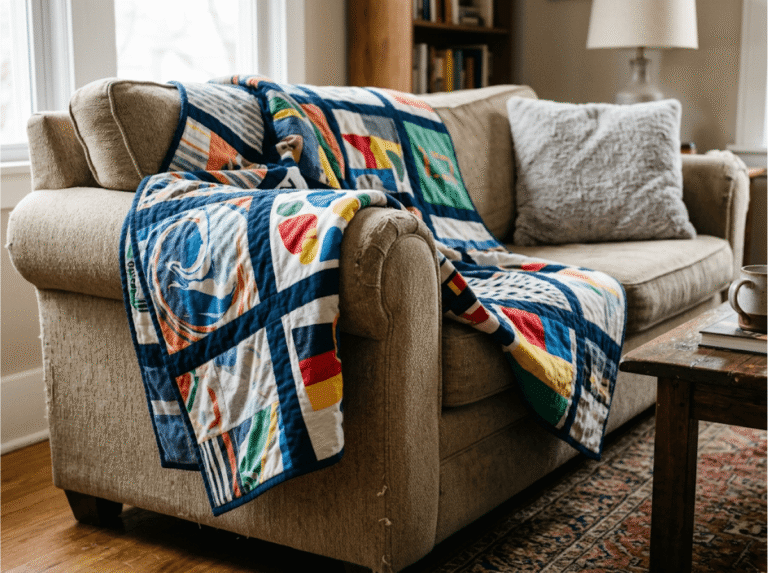
A Scandinavian quilt uses geometric blocks (stars, hearts, weathervanes) pieced in a high-contrast Nordic palette of navy, crimson, cream, or charcoal. Most blocks use half-square triangles and basic squares. Visual complexity comes from color contrast, not construction difficulty. Start with one test block before committing to full yardage. Download the free block PDF below.
Related: Beginner Block Quilt: 2026 Scrappy Sampler Starter Guide
Most Scandinavian quilt tutorials skip the part that matters. This guide does not.
Scandinavian quilt patterns are trending hard in 2026. Pinterest searches for Nordic quilt boards are in the thousands. Homes and Gardens named Scandi quilts a hygge design statement of the season. Reddit’s quilting community has active threads on aesthetics, and the conversation keeps coming back to the same question: how do you actually start without wasting fabric?
This guide answers that. One free Scandinavian quilt pattern you can finish today. A plain-language breakdown of the color and fabric decisions most tutorials skip. And a downloadable PDF with the full block-by-block sequence from first cut to finished quilt.
What Makes a Quilt Pattern Truly Scandinavian?
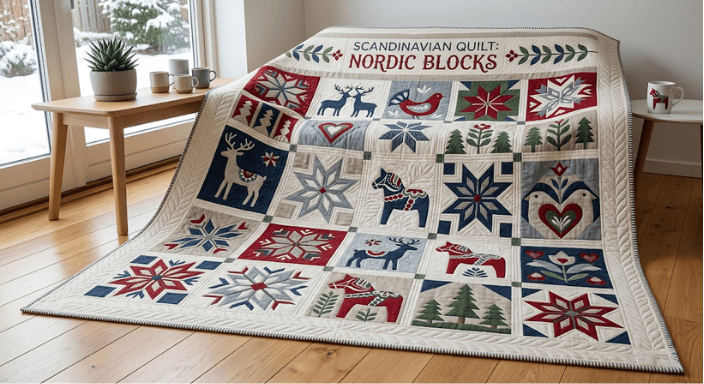
Scandinavian quilt patterns draw from Norway, Sweden, Denmark, Finland, and Iceland, but the defining characteristics travel across all of them.
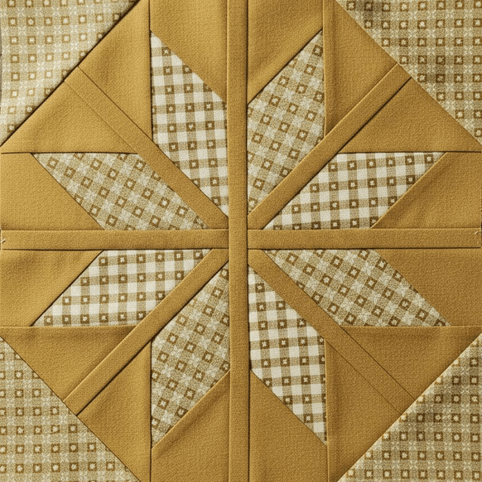
The blocks are geometric: eight-pointed stars (the Nordic Star, used for Norwegian bedcovers since the 19th century), heart blocks, weathervane blocks, and strip-pieced arrangements. Most are not complicated to sew. The visual complexity comes from color contrast, not construction difficulty.
The palette reflects that restraint. A light neutral (cream, natural white, or linen gray) pairs with one or two strong accents (crimson, navy, forest green, or charcoal). Without high contrast, the geometric blocks flatten and the folk character disappears.
The hygge connection is genuine. Hygge is the Danish concept of warmth and intentional slowness, and a handmade Scandinavian quilt is a more credible expression of it than most things you can buy. As Homes and Gardens noted in 2025, Scandi quilts offer warmth without excess and pattern without overwhelming a room. The 2026 slow-craft movement is pushing quilters toward projects with heritage stories and long use-lives. A Scandinavian quilt delivers both.
The visual complexity of a Scandinavian quilt comes from color contrast, not construction difficulty.

- Kona Cotton Solids Waterfall collection from Robert Kaufman Fabrics
- Designed by Robert Kaufman Fabrics
- Fat Quarter Bundle includes 12 18-inch by 22-inch fat quarters
- 100% Cotton; premium quilt shop quality fabric
Which Scandinavian Quilt Pattern Matches Your Skill Level?
The most common mistake in Scandinavian quilt tutorials is presenting the most photogenic pattern first and calling it beginner-friendly. Most Nordic Star patterns are intermediate projects. The folk motifs look simple but require accurate half-square triangles, which require accurate cutting, which is a confirmed skill that takes at least one practice block to establish.
The right entry point depends on where you are starting from.
If you have completed two or more quilts, your cutting skills are confirmed. Move directly to the pattern list and choose by aesthetic preference. The Nordic Star, Swedish Weathervane, and Scandi Heart block are all within reach for a returning quilter.
If this is your first quilt or you are returning after a long break, start with a test block before buying full yardage. Choose a two-fabric block in your intended Nordic palette. Complete it, press it flat, and measure it. If the block hits its target dimensions within an eighth of an inch, your cutting is calibrated, and you can commit to the full project. If it does not, the problem is upstream: cutting, not sewing. That thought comes from repeating an uncorrected cutting error across twenty blocks before discovering it was never a talent problem. Fix the cutter before the project starts. For help calibrating your rotary cutter and cutting mat, see
If you arrived here through interior design or lifestyle content, start with three questions before choosing any pattern.
- Where will this Scandinavian quilt live: bed, reading chair, or wall hanging?
- What is your room’s dominant neutral?
- How many hours per week can you realistically sew?
The answers determine your size target and palette before you look at a single block. A Scandinavian quilt made for a specific room and a realistic time commitment has a measurably higher completion rate than one chosen for how it looked on a mood board.
Pattern reference by skill level:
| Pattern | Skill Level | Block Type | Time per Block | Fat-Quarter Friendly |
| Nordic Heart | Beginner | HST + squares | 1 to 2 hours | Yes |
| Scandi Strip Block | Beginner | Strip piecing | 45 minutes | Yes |
| Swedish Weathervane | Beginner/Intermediate | HST + squares | 1.5 to 2 hours | Yes (charm packs) |
| Scandinavian Star (simplified) | Intermediate | Strip-pieced star | 2 to 3 hours | Yes |
| Nordic Star (full) | Intermediate | HST-heavy | 3 or more hours | Partial |
Complete one test block before buying full yardage for any Scandinavian quilt project.

- Includes 12x18 inch double sided, self-healing rotary cutting mat; Splash 45mm Rotary Cutter; 6x12 inch Frosted Advantage ruler
- For use with quilting, sewing and other craft projects
- 1. 5mm triple layer heat welded self-healing cutting mat
- Rotary cutter has quick-blade change with blade cover for additional safety
- Ruler: Frosted acrylic allows bold imprinted numbers to be read effortlessly over light or dark materials; Frosted, glare-free surface is non-slip for extra stability and safety when cutting
How Do You Choose Fabric for a Nordic-Inspired Quilt?
The palette decision is a technique decision. Nordic block design only works when the contrast between your light neutral and your accent color is strong enough to carry the geometry from across the room. Choose fabric where your two main colors read as clearly distinct at three feet. If they blend at a distance, the blocks disappear, and the Scandinavian quilt character disappears with them.
Step 1: Confirm your palette in the room where the quilt will live.
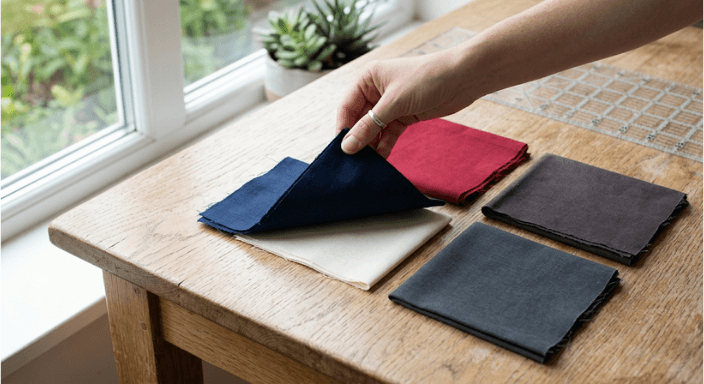
Pull swatches in your intended Nordic colorway and lay them on the floor in the actual room. Natural light changes what you see. Navy and cream look different at noon than they do under a lamp at 7 PM. A contrast that reads cleanly in a fabric shop can read as muddy in your bedroom. Spend three minutes on this before you spend $60 on fabric.
Step 2: Buy 100 percent quilting cotton for your first Nordic quilt.
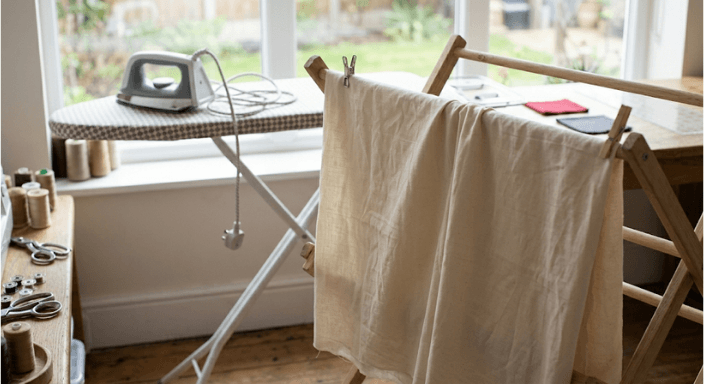
Quilting cotton has a consistent thread count, minimal stretch, and predictable behavior at both the cutting mat and the pressing board. Heavier apparel cotton or home décor fabric introduces seam bulk at block joins, which is the single most common reason beginner quilt blocks fail to lie flat. Lighter quilting cotton presses crisply and lets seam allowances sit without fighting each other.
Pre-wash your fabric before cutting. Cotton shrinks. A Scandinavian quilt made with unwashed fabric can distort after its first wash, particularly when mixing fabrics from different manufacturers.
Step 3: Cut one test square before cutting anything for the project.
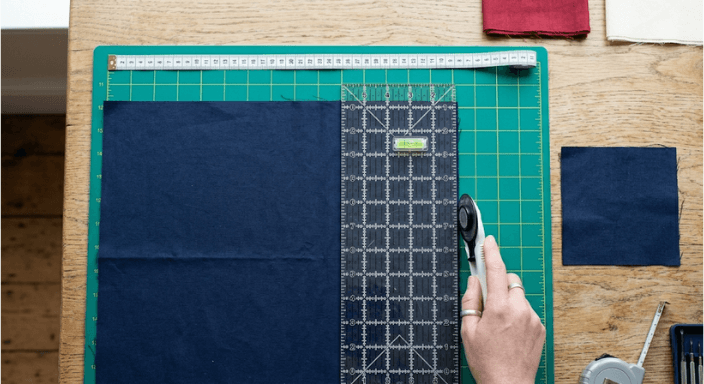
Cut a 4.5-inch square from each fabric in your palette. Measure each square on all four sides. They should be exactly 4.5 inches. If they are not, correct your rotary cutter alignment, ruler placement, or mat position before starting the project. This takes under five minutes and prevents the compounding block misalignment that most beginners attribute to sewing skill.
One maker described what happens when this step gets skipped: “I spent $50 on fabric, and the whole thing puckered. I don’t even know if it’s the tension, the needle, or if I broke the machine.” (Reddit, r/sewing) In a Scandinavian quilt with geometric blocks, the upstream error is almost always cutting.

- 1/8" or 1/16" ruler markings along 2 edges of ruler for measurement and placement accuracy
- 1/8" grid pattern on all rulers, except 9-1/2"; plus 1/2" additional width includes seam allowances
- Perpendicular dot and line grid on 6-1/2" and 9-1/2" rulers form square outlines to aid in squaring up quilt blocks
- Patented double-sight lines for visiblity on light and dark fabrics
- 45° diagonal line for aligning pattern while squaring up quilt blocks

Fat quarter math for a throw-size Scandinavian quilt (approximately 50 by 65 inches):
Two-color palette: 6 to 8 fat quarters. Three-color palette: 8 to 12 fat quarters. Always buy one extra fat quarter of your background neutral. Cutting errors in the first blocks reduce usable neutral yardage faster than most beginners expect, and running short on the background fabric is the most common mid-project disruption in a Scandinavian quilt with a light neutral base.
Cutting precision is the upstream variable that determines whether a Scandinavian quilt top lies flat.
Which Free Scandinavian Quilt Patterns Should Beginners Start With?
Each pattern below is listed in order of construction complexity. Start at the level that matches your confirmed skill, not your ambition.
1. Nordic Heart Block
Two fabric colors. Half square triangles and squares. The heart reads as distinctly Scandinavian in navy and cream or crimson and natural. This is the recommended first block for any quilter who has not yet confirmed cutting accuracy. Complete one block before buying yardage for the full quilt. Free pattern available at FaveQuilts.com (search “Scandinavian heart block tutorial”).
Download the free Scandinavian Quilt Block Starter Guide PDF here for the Nordic Heart Block cutting dimensions, full pressing sequence, and the complete beginner-to-intermediate escalation map. (Email capture gate.)
2. Scandi Strip Block
No complex shapes. Strip piecing in a Nordic palette produces a Scandinavian quilt that reads through color alone: navy, cream, and charcoal strips in clean horizontal geometry. This is the fastest path to a finished quilt for a returning quilter who wants a result on the reading chair before the season ends. Skill level: Beginner. Time per block: 45 minutes.
3. Swedish Weathervane Block
Charm-pack friendly. Half square triangles and basic squares in a four-pointed arrangement that echoes traditional Nordic folk weathervane imagery. This is the first pattern in the list that benefits from a flat layout surface before assembly: lay out the pieces and confirm orientation before the first seam. Free tutorial at FaveQuilts.com (search “Swedish weathervane block tutorial”). Skill level: Beginner to Intermediate. Time per block: 1.5 to 2 hours.
4. Scandinavian Star (simplified)
A strip-pieced star block that produces the visual read of the full Nordic Star without the complex half-square triangle point work. This is the intermediate stepping stone in a Scandinavian quilt skill progression. Complete four of these and confirm point accuracy before attempting the full star. Skill level: Intermediate. Time per block: 2 to 3 hours.
5. Nordic Star (full)
The conversation quilt. An eight-pointed star built from precision half-square triangles, with a Norwegian sengeteppe tradition behind it dating to the 19th century. This is the goal pattern, not the starting pattern. Build up to it through the blocks above. One maker described the payoff of a finished Scandinavian quilt: “My clothes look store-bought, and people actually ask where I got them. That is the ultimate compliment.” (PatternReview.com) A finished Nordic Star earns exactly that response. Full Nordic Star tutorials available at Scandiquilts.com and CraftGossip Quilting. Skill level: Intermediate. Time per block: 3 or more hours.
The Nordic Heart block is the most beginner-accessible entry point for a first Scandinavian quilt.
How Do You Start Your First Nordic Quilt Block Without Wasting Fabric?
The Scandinavian quilt has been on the mood board long enough. The pattern is accessible. The fabric decision is not complicated once you anchor it to a palette and a room. The skill level is within reach for most hobby quilters, provided you start at the right block and calibrate your cutting before the project begins.
Here is the action stack.
- Answer the three pre-project questions: where does this Scandinavian quilt live, what is your room’s dominant neutral, and how many hours per week can you sew?
- Choose your palette from the four core Nordic colorways: navy and cream, crimson and cream, charcoal and natural, or forest green and cream.
- Buy 100 percent quilting cotton. Pre-wash before cutting.
- Cut one test square from each fabric. Measure it on all four sides. Confirm cutting accuracy before the project starts.
- Complete one Nordic Heart Block or Scandi Strip Block before buying full yardage.
- Download the free Scandinavian Quilt Block Starter Guide PDF for cutting dimensions, pressing notes, and the full escalation map.
A finished test block is the only reliable permission slip to commit to full yardage on any Scandinavian quilt.
Check this Nordic Star Block Table Runner Pattern Tutorial from RaschWorks
Frequently Asked Questions
-
What is a Scandinavian quilt pattern?
A Scandinavian quilt pattern is a quilt design based on Nordic folk motifs and geometric blocks from Norway, Sweden, Denmark, and Finland. Common shapes include eight-pointed stars, heart blocks, and weathervane blocks, pieced in a restrained palette of one or two accent colors against a light neutral. Visual character comes from color contrast more than construction complexity.
-
What is the easiest Scandinavian quilt block for beginners?
The Nordic Heart block is the most accessible entry point. It uses two fabric colors, requires only half-square triangles and squares, and can be completed in one to two hours. The shape reads as distinctly Scandinavian because of color contrast, not the construction difficulty. Complete one before committing full yardage to any larger Nordic quilt project.
-
What fabric should I use for a Scandinavian quilt?
Use 100 percent quilting cotton for your first Nordic quilt. It cuts cleanly, has minimal stretch, and presses flat consistently. Those qualities matter because Scandinavian quilt block accuracy depends on flat, square pieces that align at every join. Avoid home décor fabric or apparel cotton: the added weight creates seam bulk at block corners and makes accurate piecing harder.
-
Why don’t my quilt blocks line up at the corners?
The most common cause is a cutting error, not a sewing error. If your block dimensions are off by even a sixteenth of an inch, that misalignment compounds across every subsequent block. Cut one test square, measure it on all four sides, and correct your cutting setup before re-sewing anything. Re-cutting is almost always faster than re-sewing.
-
What colors are used in traditional Scandinavian quilts?
Traditional Nordic quilts use a light neutral (cream, white, or linen gray) paired with one strong accent: crimson, navy, forest green, or charcoal. The pattern reads because of the high contrast between the two. Choose your palette so the main fabrics are clearly distinct at three feet. If they blend at a distance, the geometric block character disappears regardless of piecing accuracy.
-
Is hygge quilting the same as Scandinavian quilting?
Hygge quilting describes the intent (slow, intentional making for home comfort and warmth) rather than a specific block type. A Scandinavian quilt is the construction method. Most hygge quilts use Nordic geometric blocks because the heritage aesthetic reinforces the handmade, slow-craft character on which the style is built. The two concepts overlap but are not interchangeable.
-
How much fabric do I need for a throw-size Scandinavian quilt?
A standard throw (approximately 50 by 65 inches) requires 8 to 12 fat quarters for a two or three-color Nordic palette. Always buy one extra fat quarter of your background neutral. Cutting errors in the first few blocks reduce usable yardage faster than expected, and running short on the background fabric is the most common mid-project problem in a Scandinavian quilt with a light neutral base.
Why did you vote that way? Drop your take in the comments.