
Quick Look
Related: Free Beginner Quilting Patterns: Your No-Stress First Quilt Guide
What Makes a Quilt Block “Vintage” in the First Place?
A block earns the word “vintage” from its era and its fabric, not from how it was sewn.
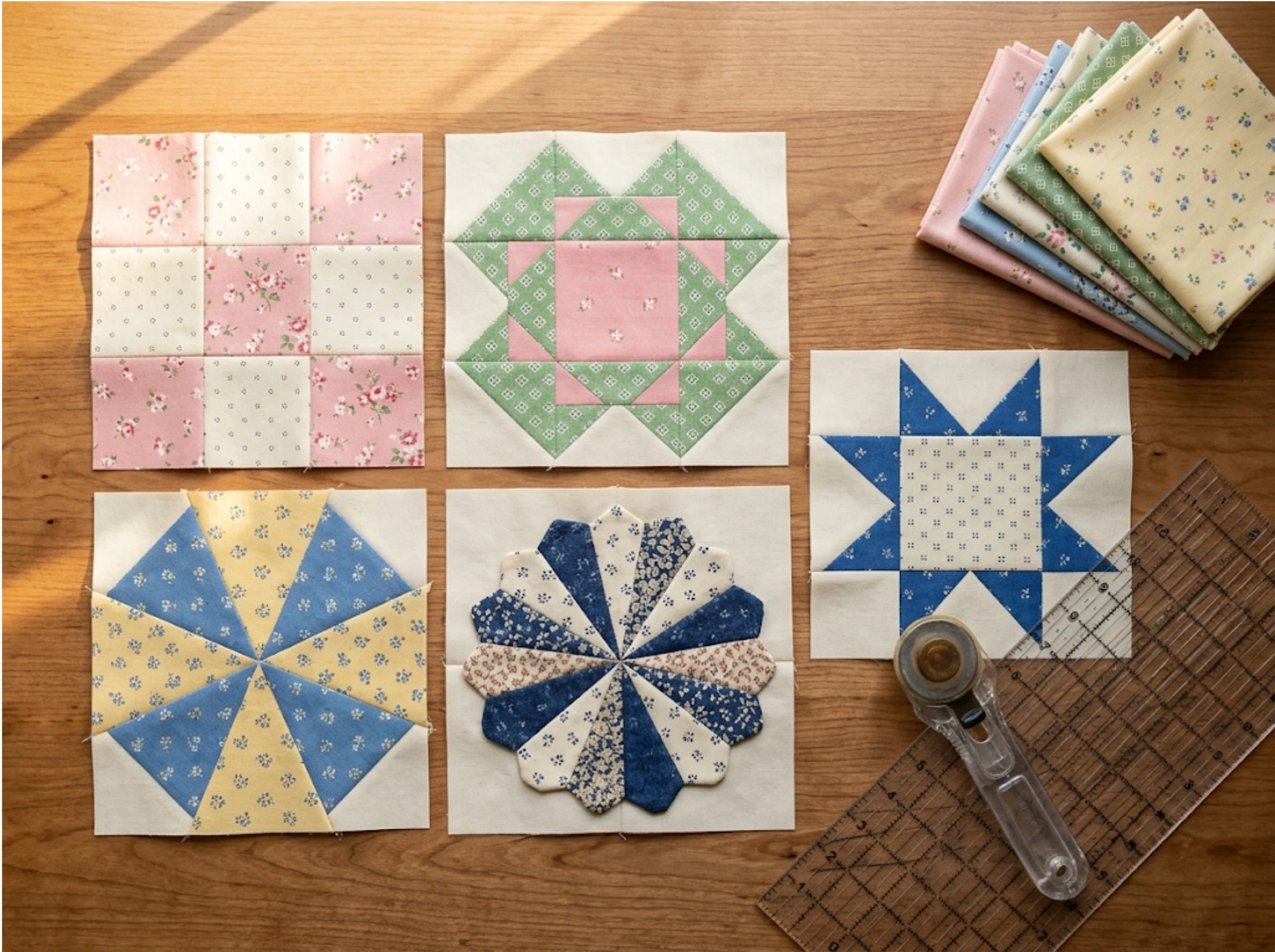
Nine Patch, Churn Dash, Bow Tie, Ohio Star, and Dresden Plate trace back to the feed sack era, when printed cotton dry goods sacks became a dress, a pillowcase, or a quilt block. One quilter, remembering her own childhood, put it simply on Quiltingboard Forums: “I had dresses made from those sacks.” Quilt historians at the International Quilt Museum have pushed back on the idea that this was purely a poverty craft, and the American Folk Art Museum’s research agrees. Using many fabrics also showed what a family could access. This guide applies modern patchwork techniques to all five blocks. The only prerequisite skill is a straight quarter-inch seam and pressing as you go.
Which 5 Blocks Belong in a Beginner’s Vintage Rotation?
Piece these blocks in order, since each one adds exactly one new skill on top of the last.
Start with Nine Patch for straight seam accuracy, then Churn Dash for half square triangles. Bow Tie teaches a set in a corner, the modern way. Ohio Star adds precision trimming, with the most seams meeting at one point. Dresden Plate closes the set with curved piecing and a real finishing decision. These five modern patchwork techniques build on each other, so skip ahead, and the missing seam accuracy from block one shows up right at the plate’s points.
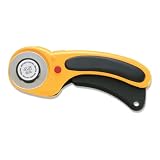
- RAZOR SHARP 45MM ROTARY BLADE - The RTY-2/DX is pre-loaded with an RB45-1H Endurance Rotary Blade. The ultra-sharp rolling razor blade delivers unparalleled sharpness and superior edge retention for twice the life of a standard rotary blade.
- SQUEEZE TRIGGER HANDLE - Easy squeeze handle exposes the blade and self-retracts for safety. The curved handle with anti-slip rubber grip reduces hand fatigue and stress. The integrated grooves help prevent finger slippage.
- QUICK & EASY BLADE REPLACEMENT - OLFA's 45mm Rotary Cutter has a blade system that provides simple and safe blade changes. The dual-action safety lock allows the blade to be locked while open or closed.
- INTRICATE & ACCURATE CUTTING - Provides detailed and precise cutting of a variety of materials including cotton, wool, paper, vinyl, leather, and more. Also fits our Pinking Blade (PIB45-1), Scallop/Peak Blade (SCB45-1), and Wave Blade (WAB45-1).
- THE OLFA STANDARD - As the inventor of the Rotary Cutter in 1979, OLFA has maintained a standard of cutting excellence for our quality and durability. Pairing OLFA brand rotary cutter, blades and cutting mats together will provide optimal results.
How Do You Piece a Nine-Patch the Modern Way?
Strip piecing turns nine separate squares into two seams and a stack of cuts.
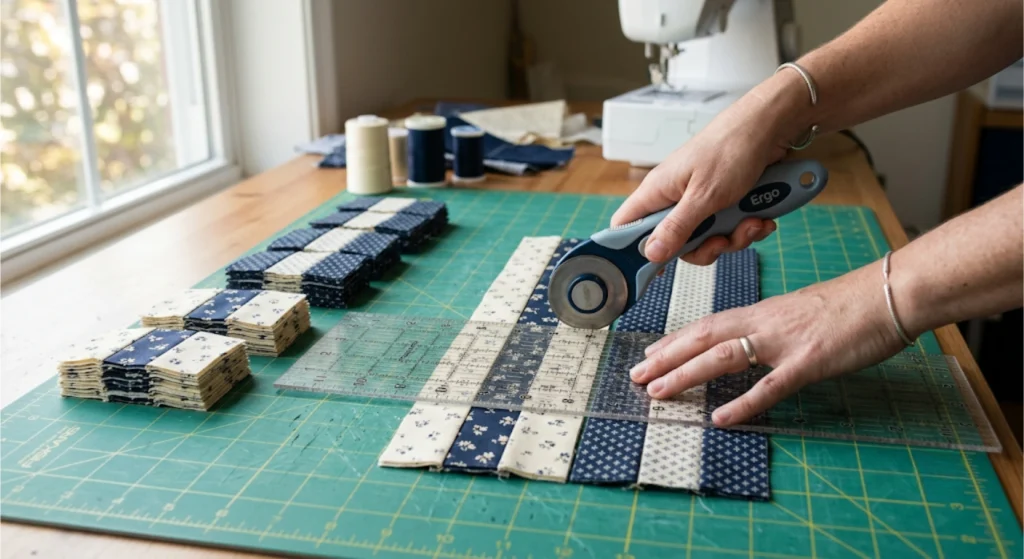
The original Nine Patch was pieced one small square at a time, nine separate seams before the block was even square. Modern patchwork techniques skip straight to strip piecing instead, using rotary cutting basics.
- Sew fabric strips into a light dark light strip and a dark light dark strip, then press both toward the darker fabric.
- Cross-cut both strips into segments equal to your strip width, then arrange and sew three segments into rows.
How Does the Churn Dash Block Use Grid-Method Triangles?
One drawn line and two seams replace eight individually cut and matched triangles.
Churn Dash needs half-square triangles at each corner, traditionally traced, cut, and pinned by hand. One of the more useful modern patchwork techniques here is the half square triangle grid method, which collapses that into one drawn line and two straight seams.
- Layer a light and dark square right sides together, then draw one diagonal line from corner to corner on the wrong side of the light fabric.
- Sew a scant quarter-inch seam on both sides of the line, then cut apart on the line for two finished half-square triangles at once.
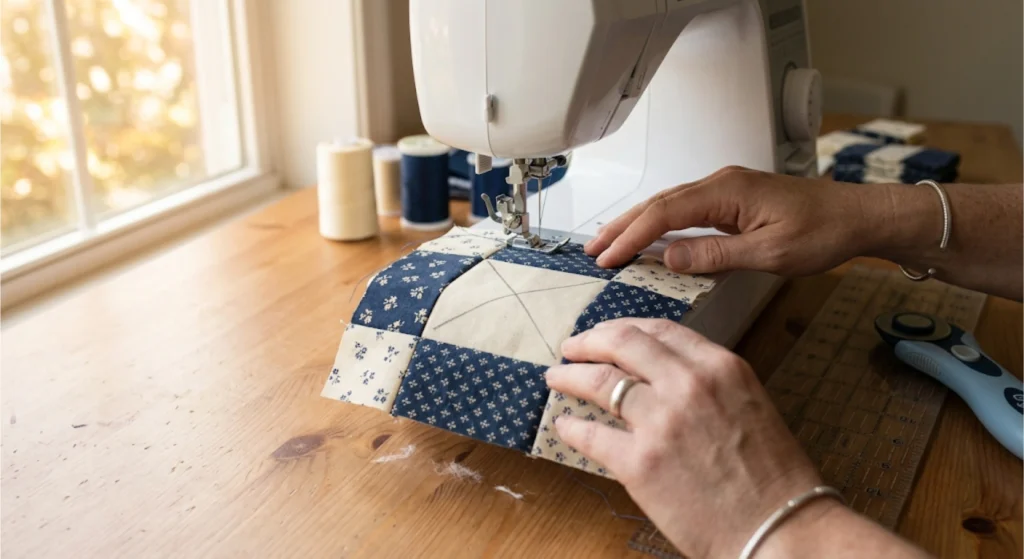
One maker on Quiltingboard Forums summed up its appeal: “I think churndash is the perfect block!” The plain center square gives a favorite print somewhere to shine
What’s the Modern Shortcut for a Bow Tie’s Set-In Corner?
A stitch and flip corner fakes the look of a set-in seam without the set-in seam.
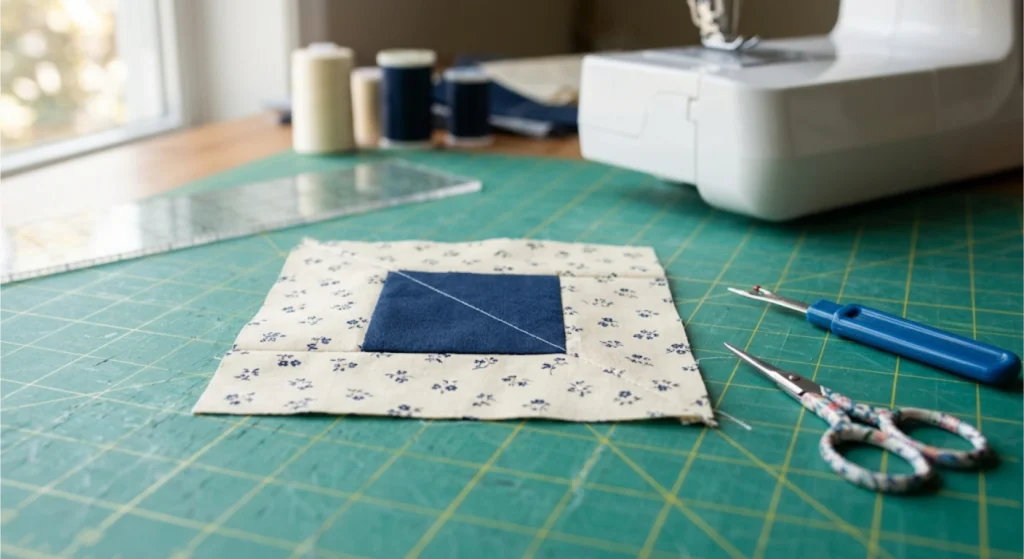
Traditional Bow Tie relies on a set-in Y seam, a tricky move in hand piecing. Stitch and flip is the fastest of these modern patchwork techniques: sew a small contrast square onto the corner, trim the excess, and press it open.
- Place a small corner square right sides together on the corner of the main piece, aligned to the raw edges, and sew corner to corner across it.
- Trim the excess fabric a quarter inch from the new seam, then press the corner open flat.
Quilters are split here. Some say a true set-in seam sits flatter once hand quilted. Others find stitch and flip invisible after pressing, with less pucker risk.
How Do You Keep an Ohio Star’s Points Sharp?
Trim every unit to the same size before you sew the block together, not after.
Ohio Star packs the most seams into one intersection of any block here, so sharp points depend on one habit: trimming last. A no-waste flying geese method, one of the quicker modern patchwork techniques, yields two star point units from a single pass at the machine.
- Layer a large square with two small squares in opposite corners, sew both diagonals, then cut and press to reveal two flying geese units at once.
- Trim every finished unit, corners, and star points alike, to the identical measurement before assembly.
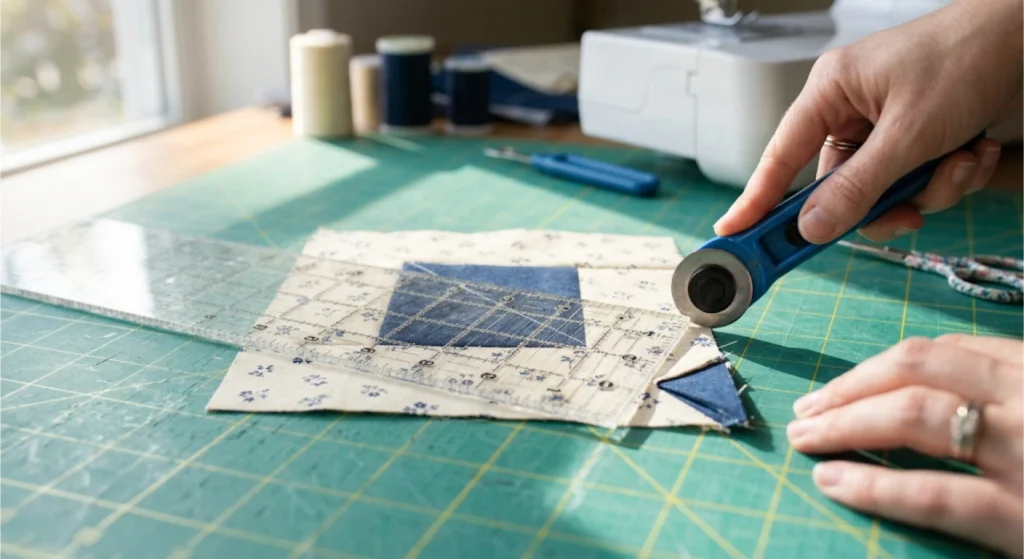
A blunted star point rarely means a sewing mistake. It means the trim happened before the seam was pressed flat [3], or not at all.
Is Machine-Finishing a Dresden Plate Petal Actually Fine?
Test your actual fabric before deciding how to finish the petal edge, since that decision can’t be made from habit alone.
The Dresden Plate is the block that made feed sack quilting recognizable. It’s also where modern patchwork techniques meet a genuine trade-off, right at the curved or pointed petal edge.
- Cut wedge shapes with a Dresden ruler, sew into pairs, then quarters, then a full plate, pressing seams in one consistent direction.
- Press a test scrap of your actual background and plate fabric together first, then choose hand appliqué basics, a machine straight stitch, or a narrow zigzag based on how that scrap’s folded edge holds up.
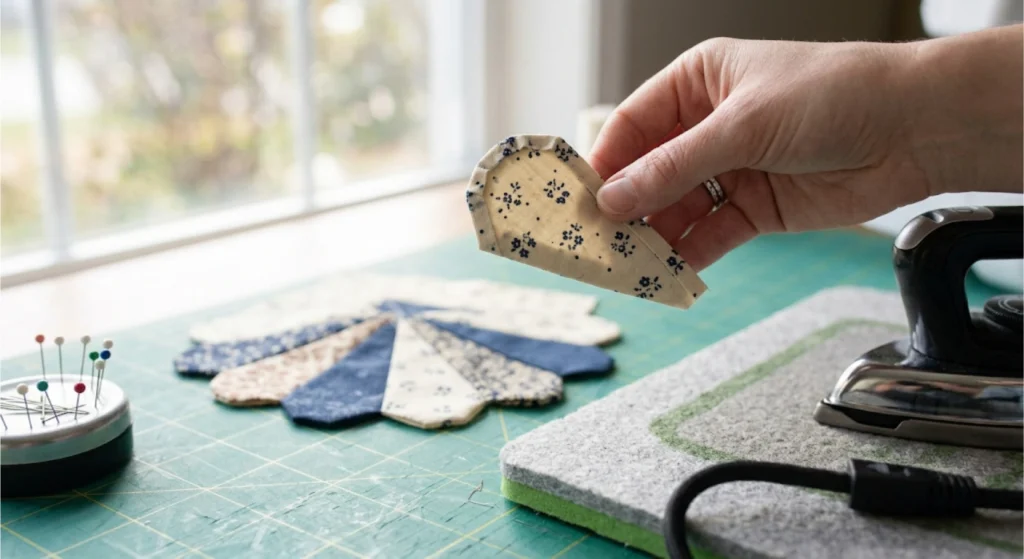
Original feed sack cotton runs coarser than most reproduction prints, as one Quiltingboard Forums member put it: “rougher than fabric we find today from our LQS.” Coarser fabric can hold a pressed fold better than smoother prints, which is why the fabric test matters more here than in most of these modern patchwork techniques.
Should You Buy New Fabric or a Piece From Your Stash First?
Check your own scrap bin before buying a bundle marketed as vintage style.
Feed sack quilters didn’t shop for a curated look; they used what came free with the groceries. Buying a bundle to chase that look repeats the habit those quilters worked around. One Quiltingboard Forums member asked the obvious question: “Why would anyone buy feedsack fabric when you got it free with the flour?” Reproduction prints still earn a place among these modern patchwork techniques, since good 1930s yardage has gotten harder to find. Use it to fill a real color gap, not as a mandatory purchase.

- Made in the USA with high quality acrylic and precision measurements ensuring accuracy for your quilting, sewing, patchwork, and crafting projects.
- Creative Grids exclusive non-slip grip allows you to easily slide the ruler over the fabric until positioned correctly. Then, when slight pressure is applied, the grip holds the ruler in place, eliminating slipping while you cut.
- Easy to read black and white markings are printed in 1in grids marked in 1/8in and 1/4in increments.
- Use the black numbers printed on white dots and the 1/4in grip sides to cut in whole inches.
- Use our exclusive Turn-a-Round feature to easily cut in 1/2in increments by following the white numbers on black dots and 1/2in grip sides.
Which Block Should You Start With Today?
Start with Nine Patch, even if Dresden Plate is the one you actually want to make.
These five modern patchwork techniques get a beginner to a finished, accurate block faster than hand piecing did, without pretending the process is instant. Piecing all five, cutting and pressing included, runs across several sewing sessions, and Dresden Plate deserves its own session the first time through. Start with the block that teaches the skill you’re missing, and save quilt sashing and assembly for once all five are done.
Get the Printable Vintage Block Companion Guide
A free printable guide walks through all five modern patchwork techniques, start to finish, so you’re not piecing from memory.
Download the companion guide covering all five modern patchwork techniques to keep at your sewing table while you piece.

- Made in the USA with high quality acrylic and precision measurements ensuring accuracy for your quilting, sewing, patchwork, and crafting projects.
- Creative Grids exclusive non-slip grip allows you to easily slide the ruler over the fabric until positioned correctly. Then, when slight pressure is applied, the grip holds the ruler in place, eliminating slipping while you cut.
- Easy to read black markings.
- 1/4in dashed lines along both angled sides to show the seam allowance.
- Center line is clearly defined for even more design possibilities.
Affiliate disclosure: this article may include affiliate links. If you purchase through one, we may earn a small commission at no extra cost to you. Tool recommendations are pending hands-on editorial testing and marked accordingly.
Jackie Loos – JunkGal63 Studio‘s Can You Make This Nearly 100-Year-Old Quilt Block? Vintage Cross & Crown
Frequently Asked Questions
-
Do I need special tools to make these vintage quilt blocks?
A rotary cutter, a self-healing mat, and a quilting ruler make the modern patchwork techniques in this guide faster. A Dresden ruler helps with the fifth block specifically. None of these is strictly required. Every technique here can also be done with scissors and a traced template, the traditional way.
-
Can I use quilting cotton instead of real feed sack fabric?
Yes. Reproduction 1930s prints are the practical choice for almost every quilter today. They are woven more consistently than original feed sack cotton, which tends to be coarser and fray more at a cut edge, so a test scrap before cutting is still worth doing.
-
Why does my Churn Dash block look lopsided even though I followed the pattern?
The most common cause is trimming half-square triangle units to slightly different sizes before assembly. Even an eighth of an inch of difference between units shows up as a lopsided center. Trim every unit to the same size with a ruler before you sew the block together.
-
How do I fix a Dresden Plate petal that puckers at the point?
Puckering at a folded petal point usually means the point wasn’t pressed flat before the next fold was added. Unpick the fold, press the point flat and dry, then re-fold. One long-running discussion on Quiltingboard Forums noted that heavy starching helps prevent this, since starched fabric is much less likely to stretch while you work it.
-
How long does it realistically take to piece all 5 blocks?
Plan for several sewing sessions, not one afternoon, especially the first time through the Dresden Plate. A confident beginner can usually piece the first four blocks in an evening each. The Dresden Plate takes longer because of the curved finishing step at the end.
-
Were feed sack quilts always made from poverty, not choice?
Not entirely. Quilt history research shows that using many different fabrics in one quilt was partly a resourcefulness habit, but it also signaled how many fabrics a family had access to, functioning as a small status marker even during hard times.
-
Do all 5 blocks need to finish at the same size to go in one quilt?
Yes, if you want them in a single sampler quilt without extra piecing. Finish all five blocks to the same unfinished measurement before joining them with sashing strips. If sizes come out uneven, trim the larger blocks down rather than stretching the smaller ones.
Why did you vote that way? Drop your take in the comments